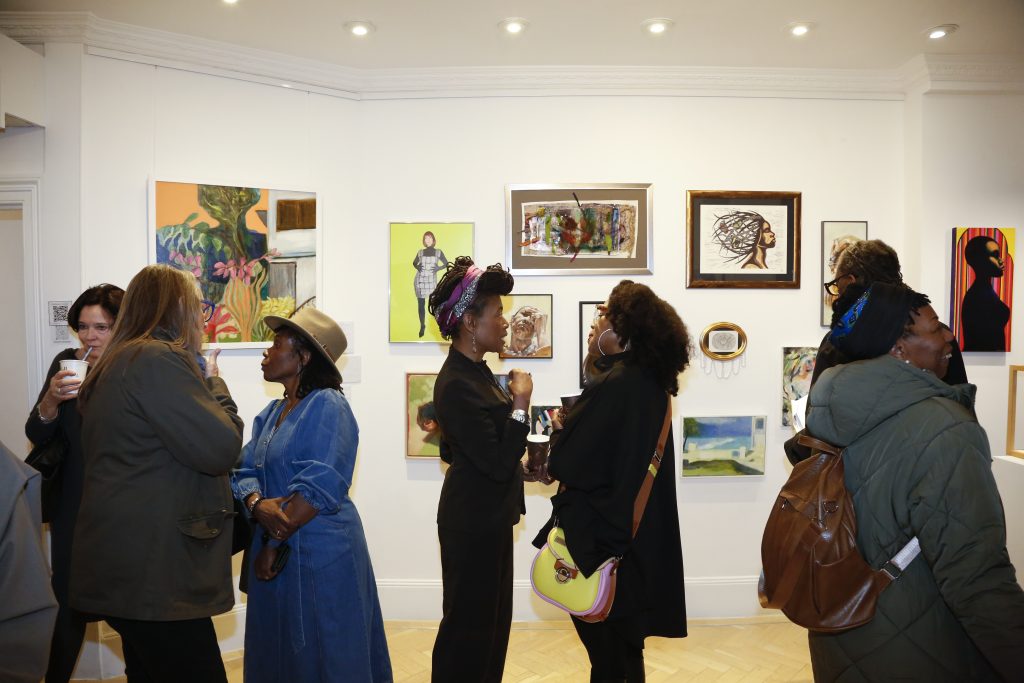


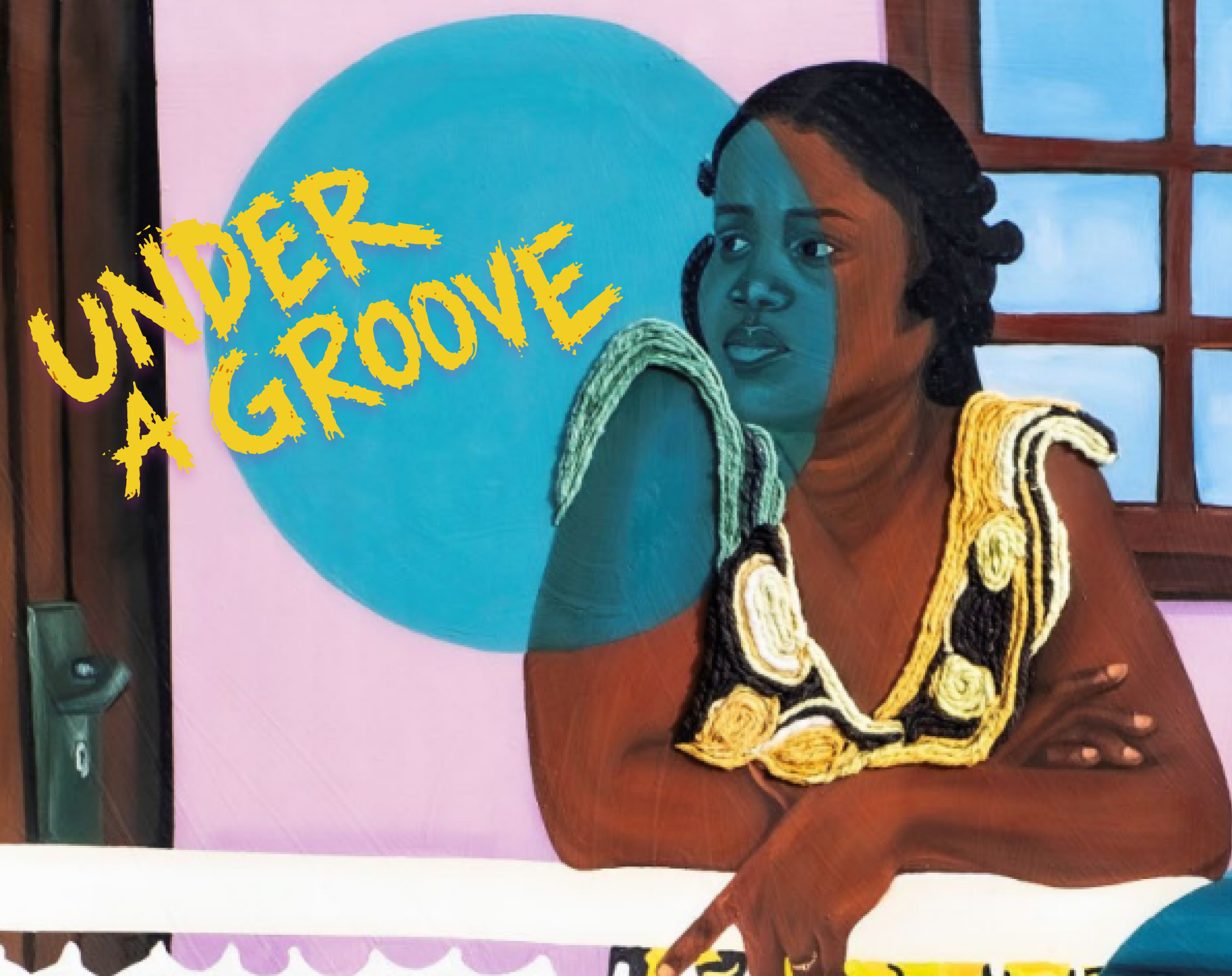
Under a Groove takes its cue from Funkadelic’s One Nation Under a Groove, using rhythm as a metaphor for connection. A way of connecting through the rhythm that moves through our eardrums and through the idea that different people, histories and experiences can occupy a shared space while retaining their individuality.
Bringing together Paul Majek, Raymond Soko, Cecilia Lamptey Botchway, Kwesi Awotwi and Sophia Oshodin, Under a Groove considers the many forms that community can take and the different shapes that can emerge through the journey of finding and becoming community. Across the works, ideas of home, family, friendship, spirituality, memory and cultural inheritance overlap and diverge. Together, they ask us to consider not only where we belong, but how our relationships with others shape who we become, what we become, and the connections we form in finding our individuality.
When two nations collide, two worlds that have always been one meet. One may have been left to build another on its own, yet the two have always remained intertwined. We find ourselves in each other constantly, in different ways. We continue to meet each other in passing, catching glimpses of one another in the mundane, beside one another, walking down and past one another, with a comforting gaze.
I am because we are. Ubuntu.
Nigeria and Ghana ….We are one in the way we move and communicate, in our collective memory and our belonging, in our history and in our current paths that so often intertwine. More often than expected, we find ourselves under one groove. We have always been creating this rhythm that unifies us, one beat following another, forming a collective chorus while still creating our individual verses. We have a strong history showing that we were once one and we continue to move within different rhythms while remaining connected by the same underlying beat. Our oneness constantly causes us to look at ourselves; we search within ourselves and in doing so, find ourselves reflected in one another.
This is where we may encounter ‘rivalry’, the desire to constantly find differences; yet, beneath these
differences, we remain connected. People see this repeated dialogue and may believe there is a particular passage through which to enter these conversations, viewing it as a playful rivalry. Yet beneath this playfulness sits a deep-rooted history, one that also encourages connection, kinship and community.
Perhaps this is the tension of seeing ‘one’ not as the final form, but understanding ‘one’as something that brings us together. We each have our own paths, our own identities and experiences; different, but cousins.
Under a Groove looks at these similarities while also celebrating differences. It considers both the old
and the current conversations taking place across West Africa and the ways in which Nigeria and Ghana continue to meet, overlap, distinguish themselves and find one another within the same rhythm.
Memory. Memory is a tool that allows us to connect with moments and pockets of the far and near past. It allows us to return to our individual thoughts, recall moments and allow further experiences to be birthed from those same memories. Memories allow us to dream, to belong and to discover connection. Through memory, individual experiences can become collective memories, allowing us to connect with one another and understand a shared rhythm.
Paul Majek speaks to this relationship with memory: “Memory is something I have always been deeply invested in, but increasingly in its fleetingness and my relationship with my own memory; the things I decide to forget, the things I decide to remember and the things I cannot control.”
His work explores the fluidity of figures, engaging with themes of memory, generational dialogue and spirituality. We see how Paul uses colour as a record of time, seeping between moments and feelings through his use of colour. His works explore how both bodies and buildings retain traces of care, distress and memory. Throughout his practice, Majek reflects on the search for belonging and the possibility of finding home within oneself.
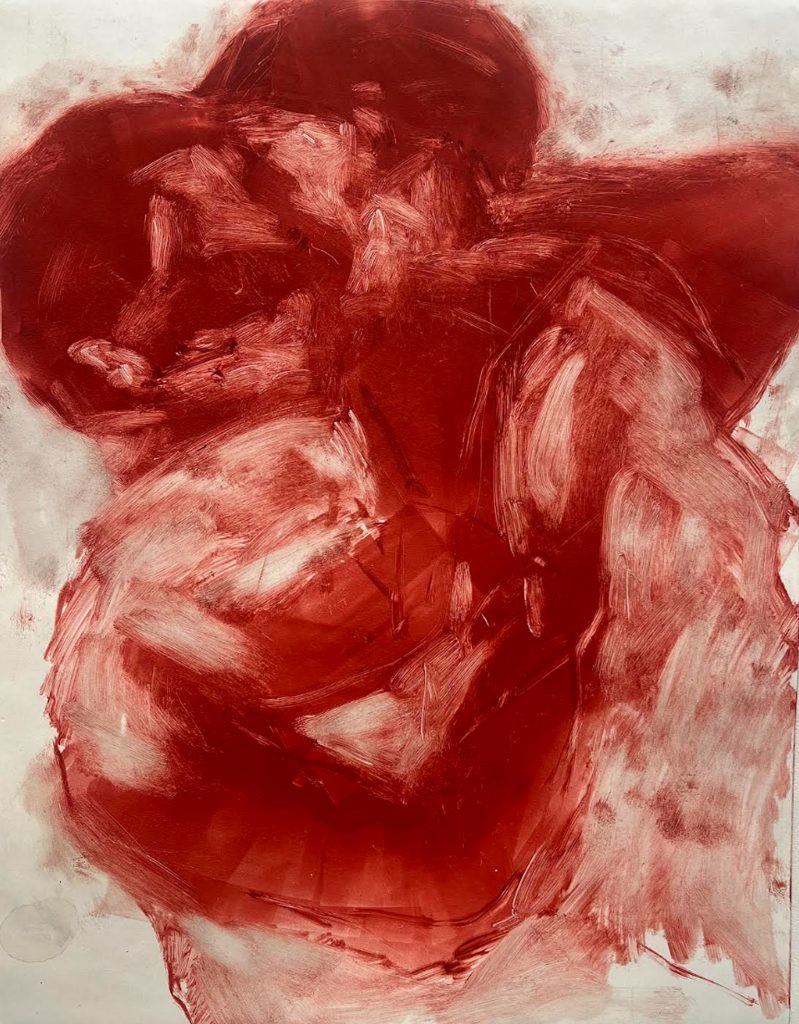
Memory is constantly embedded in places, in people, in history and in community. Slow Fire brings together elements of Paul’s evolving palette, moving between deep blues, oranges and reds and creating a sense of transition and emotional movement. The work can be read as part of a wider conversation about how our sense of belonging changes over time. Colour becomes a way of tracing this movement, from one emotional or personal state into another.
This takes us back to the idea of historical memory, culture, memories and belonging leaving imprints from the past and changing over time. The rhythm shifts, hovers, simmers; through sound, silence and movement. Continually evolving. Yet these frequent movements continue to form alliances, connections and shared experiences and moments, leading to the formation of communities.Paul shows us home as a place of memory, with a slow realisation that generational dialogue can also hold contrast. The need to find home within a sense of displacement can be found within the family archive; the need to belong can become a search for something that is carried within us.
From this starting point, the exhibition asks how that sense of belonging extends beyond the individual towards family and community. Paul’s work offers a personal point of entry into this idea, creating a space from which the exhibition can move outward, from the experience of finding home within oneself towards family, friendship, cultural inheritance and the wider communities that shape our lives.
Paul Majek’s work considers belonging through the idea of home, Kwesi Awotwi’s family portraits shift this conversation towards the people who give that sense of belonging meaning. Collective identity asks what we see in each other, what we find in one another, and how we search for ourselves in others as a way of beginning to build and form connections, connections that have always existed, even if at different points in time.
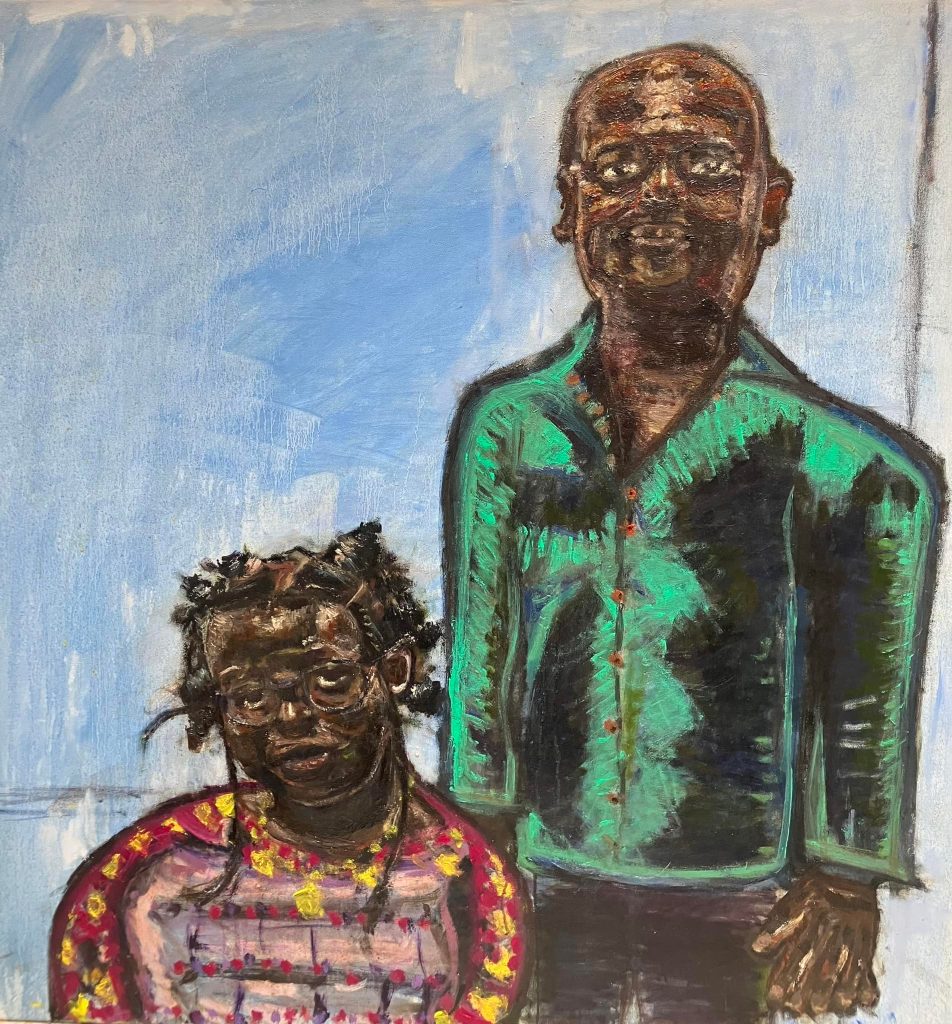
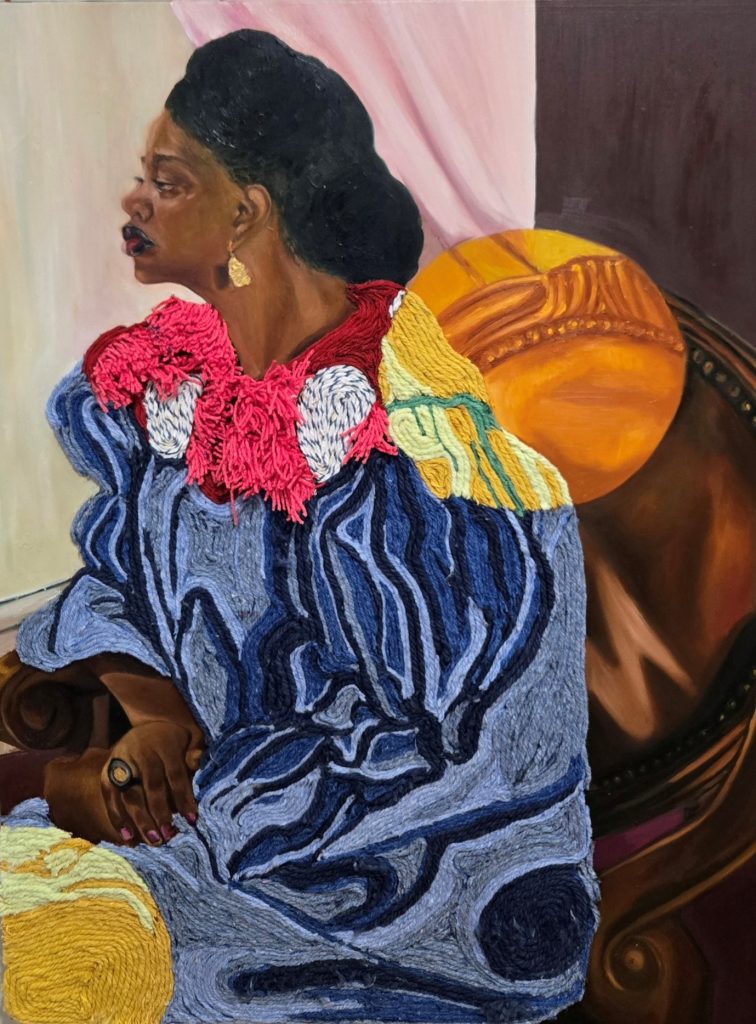
Kwesi Awotwi explores this journey of finding collective history through individual portraiture. He allows us to look at a portrait of an individual and still be able to see, sense and feel ourselves within it. This can be easily translated through Kwesi’s work, as he repeatedly taps back into his community, painting family, painting the community he sought out first. To document family allows a right of passage to revisit memories, sit within the same memories, or express them in ways that may not be visible at first glance.Kwesi’s exploration of proportion within his figures also taps into the history of both Western and African depictions of Black people. His portraits therefore become more than individual representations; they open up questions around how Black people have been seen, represented and remembered.
Similar to Paul returning to his family archives and layering past, present and future memories, Kwesi creates a space where memories and experiences can exist beyond the immediate image. There is a dreamscape within the realism, where family photographs, memories and lived experiences can meet. This invites us to ask, What is remembered? How is it expressed? And who is remembered?
Portraiture allows many moments to be captured within one still image, while allowing that stillness to move in ways we could not have possibly imagined. Standing before these works can evoke feelings and encounters that extend beyond the image itself, allowing us to feel the conversations taking place between the works.Through portraiture, Awotwi places family at the centre of the image, creating space to consider the relationships, histories and connections that shape individual identity. The portrait becomes more than a record of a person; it becomes a record of relationship and a way
of preserving moments of shared life and shared memories. We are then asked to consider who and what we carry with us, and how personal identity is often formed through the people around us.
Together, the works suggest that home is not simply a physical place, but can also be found in the people, memories and relationships that we carry with us.
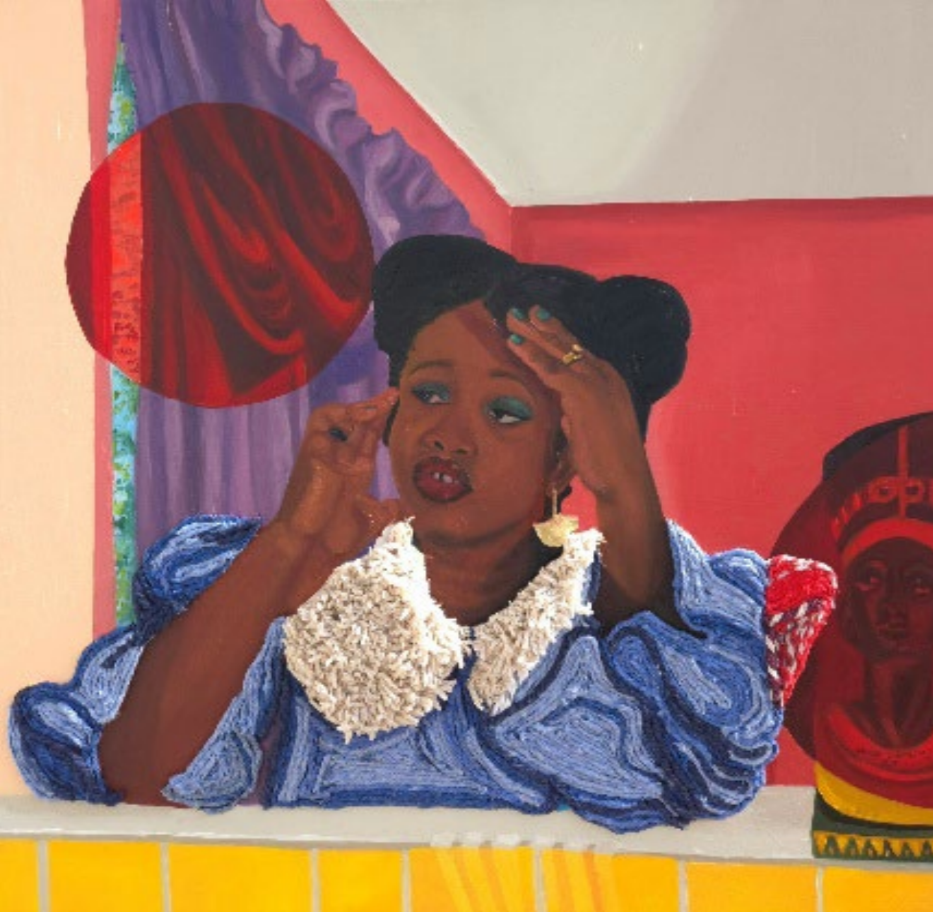
If community can be understood through the relationships we inherit, it can also be understood through the relationships we choose to build. The works of Cecilia Lamptey Botchway and Sophia Oshodin introduce another dimension to Under a Groove; friendship, sisterhood, intimacy and the possibility of community formed between women. Their inclusion also invites a wider question about whose participation has historically been recognised within African art histories.
There is this need to constantly form alliances with the women surrounding us, particularly through the internal and external battles women have to take to gain freedom of expression. In both Ghanaian and Nigerian cultures, the importance of sisterhood and female friendship has always been present. We see it in our regular gatherings, family occasions and celebrations, including our big Nigerian and Ghanaian weddings, where we put on our best aso ebi or kente. These moments show our togetherness, pockets of peace, love and joy created through memories made with our girls, with our women, further strengthening the sisterhood we form. These relationships become spaces of belonging, where we find love, care, kinship and community.
Through Cecilia’s work, this feeling is familiar, relatable and close. We are able to tap into her memories, see and understand them, and perhaps even take some of them as our own through shared memories and shared experiences. There is a familiar saying used in both our cultures: “Did we all grow up in the same household?” We ask ourselves this because we find ourselves seeing our own memories within other people recalling their own. The looks, the positions, the colours, the gestures and the stares; you can find yourself, or your memories, within Cecilia’s work.
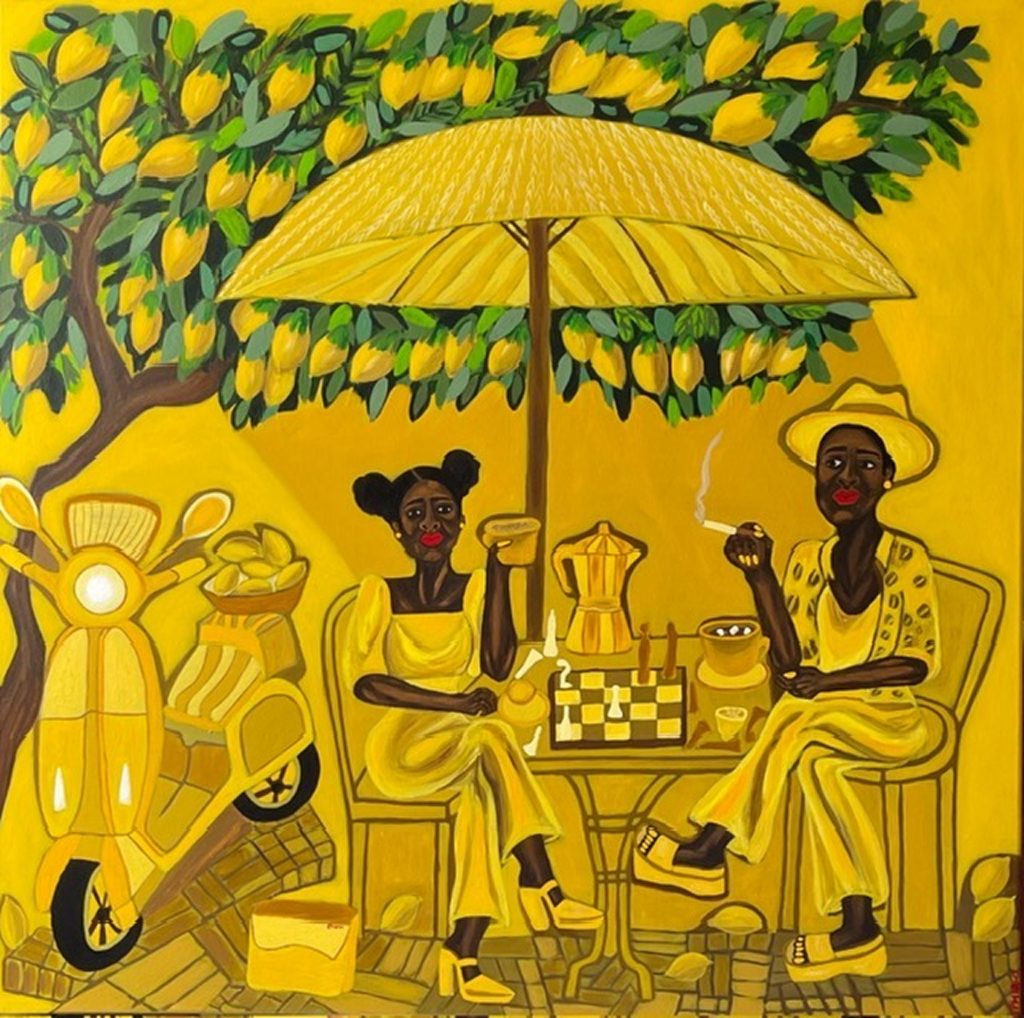
Sophia’s striking colour palette gives a persistent sense of joy. Her pieces, with multiple figures of women, allow you to recall those moments spent with your people, your circle, your girls. The bright yellows and richness of the browns create a feeling of joy that radiates from the works, allowing you once again to become caught within that feeling, recalling a memory through someone else’s.
Across African art histories, women’s participation has often been less visible in the narratives through which modern and contemporary artistic communities have been remembered. This raises an important question for the present: what does it mean to build a community around art if some of the people contributing to that community are not equally visible within its history?
Within Under a Groove, the relationship between Cecilia and Sophia offers an opportunity to consider community not simply as a historical or cultural inheritance, but as something actively created through connection, friendship and exchange. Their works bring a female perspective into a wider conversation about togetherness, while also prompting us to think about the structures through which artistic communities are formed, remembered and represented. Their presence therefore becomes significant beyond questions of representation alone. It allows the exhibition to consider what happens when community becomes a space of mutual recognition, where relationships between women can themselves become forms of cultural knowledge, support and belonging.
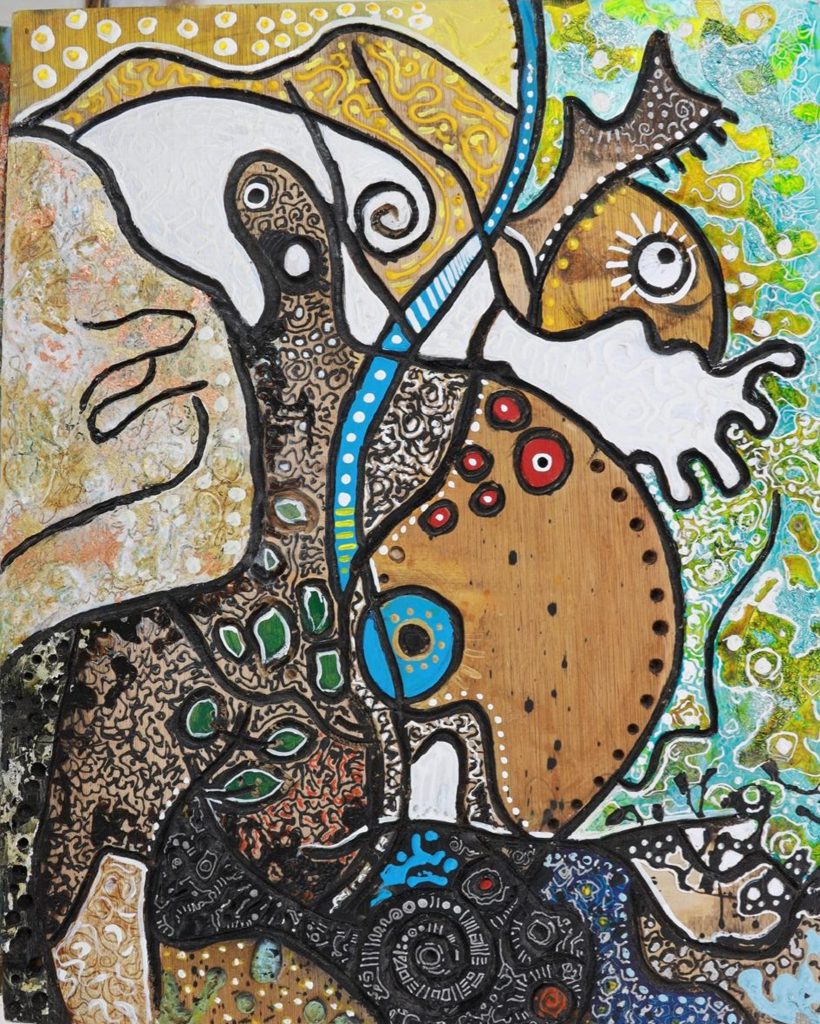
We have just considered community through relationships between people; Ray Soko’s work allows the conversation to extend towards spirituality, ancestry and cultural inheritance. His engagement with Yoruba spirituality introduces a different understanding of connection, one in which belonging can extend beyond the immediate and the visible, linking the individual to histories, traditions and ancestral knowledge.
The significance of this becomes particularly clear as we bring together Nigerian and Ghanaian artists. Under a Groove considers how cultural identity is carried across generations, but also how it is continually reinterpreted, reinvented and reimagined in the present. Ray’s work creates a space in which spirituality can be understood not simply as a personal belief, but as a relationship to culture, memory and ancestry.
Yet Under a Groove does not suggest that community is always uncomplicated, or that belonging is guaranteed through being part of a unit, a collective or a movement. Community can also let us down. The relationships and structures that provide us with connection can sometimes fail to provide the sense of belonging, understanding or support we need. This creates an important tension within the works presented, what happens when the community we look to for belonging falls short?
This is where Paul Majek’s exploration of home within oneself offers another perspective. Alongside finding community through others, there are moments when we may have to find a sense of home within ourselves. Belonging can become an internal experience, particularly in those moments when external communities fail to hold or recognise us.
Ray’s engagement with spirituality and ancestry suggests that connection does not have to exist solely through the people immediately around us. It can also be found through memory, cultural inheritance, spirituality and our relationship with ourselves.
In this context, community extends beyond those physically present around us. It can include those who came before us, the traditions we inherit and the cultural knowledge that continues to shape how we understand ourselves. This offers another interpretation of Ubuntu: our sense of self is formed through relationships, but also through the histories and experiences we carry within us through time.
Placed alongside the other artists, Soko’s work therefore expands the exhibition’s understanding of togetherness while also challenging it. Where Paul considers belonging through home and the possibility of finding home within oneself, Awotwi through family and collective identity, and Oshodin and Lamptey Botchway through friendship and female relationships, Soko introduces ancestry and spirituality as another form of connection. Together, these different perspectives suggest that community is not a single structure or guaranteed source of belonging, but a network of relationships that can support us, shape us, challenge us and at times, fall short, leaving us to discover other ways of coming home to ourselves. In this context, community extends beyond those physically present around us. It can include those who came before us, the traditions we inherit and the cultural knowledge that continues to shape how we understand ourselves. This offers another interpretation of Ubuntu: our sense of self is formed through relationships, but also through the histories and experiences we carry within us through time.
Placed alongside the other artists, Soko’s work therefore expands the exhibition’s understanding of togetherness while also challenging it. Where Paul considers belonging through home and the possibility of finding home within oneself, Awotwi through family and collective identity, and Oshodin and Lamptey Botchway through friendship and female relationships, Soko introduces ancestry and spirituality as another form of connection. Together, these different perspectives suggest that community is not a single structure or guaranteed source of belonging, but a network of relationships that can support us, shape us, challenge us and at times, fall short, leaving us to discover other ways of coming home to ourselves.
Journeying through Under a Groove, we find a rhythm; a unified tone, but with various paths through which we find togetherness, unity, kinship and community. We were never in search of a single definition of community; instead, the exhibition allows these different understandings to exist alongside one another. Home can be a physical place, a memory or something we carry within ourselves. Family can provide a sense of identity and continuity, while friendship can create forms of chosen community and mutual recognition. Spirituality and ancestry can connect us to histories that extend beyond the present, while moments of isolation or disappointment remind us that community can also fall short.
It is within these overlaps and different perspectives that the exhibition finds its rhythm. The works do not need to speak about the same experience to speak to one another. Their relationships emerge through the different questions they raise around belonging, memory, identity and connection. The exhibition becomes a meeting point, a space where personal histories can encounter collective ones and where different understandings of community can coexist without needing to become the same. It is about finding the beauty and understanding in our differences, whilst honouring and welcoming our similarities over time. This also returns us to the idea of Under a Groove. A groove is repetitive, but it is never entirely static; it creates a structure within which movement, improvisation and difference can occur. In a similar way, community requires both connection and individuality. To be part of a collective does not mean losing the self, but finding ways for individual experiences to exist within a larger rhythm.
The meeting of Nigerian and Ghanaian perspectives within the exhibition adds another layer to this conversation. Rather than treating nationality as a boundary, the exhibition creates an opportunity to consider the cultural connections, differences and exchanges that can exist across borders. The artists bring their own histories and contexts into the space, but the relationships between their works allow new conversations to emerge.
The conversations, the gestures, the lingo, the knowing that there is a mutual ground between worlds that intertwine along their individual paths. Where our verbal language may differ, in words we do not always hear, there are words we see in the art we produce, the food we eat, the colours we use, our upbringing and the ways in which we confidently wear the pride of where we come from. In different fonts, but still with the same message, Nigerians with the billboard signage, “We are here!”, and Ghanaians with their own subtle but powerful expressions of presence and pride.
We have our meeting places along our individual paths and in those moments where we meet, we find elements of ourselves, the histories, the food, the aso (clothes in Yoruba), the culture, the traditions and the ways in which we express these experiences through our art. In this, we recognise the similarities, applaud them and understand the differences. Within those differences, we birth rich conversations. We ask questions, we learn; a back and forth emerges, connection, love, laughter and unity. A mutual understanding that, even with the shield that can surround rivalry, we find comfort in knowing that we will always have our meeting points, our check-ins and our solidarity.
“Ọpọ̀ ọwọ́ ni ń gbé ẹrù.”, Many hands carry a load(Yoruba).
“Baanu soa a, ɛmmia.”, When two people carry a load, it does not weigh them down (Twi)
Community is not simply about being together; it is about what becomes possible when people
carry something together.
Under a Groove ultimately suggests that community is not a fixed place we arrive at, but something we continually create, negotiate and reimagine over time. Across the works of Paul Majek, Ray Soko, Cecilia Lamptey Botchway, Kwesi Awotwi and Sophia Oshodin, belonging takes many forms, through home, family, friendship, spirituality, ancestry and the self. The meeting of Nigerian and Ghanaian perspectives further demonstrates how cultural connections can cross borders while retaining their own histories and identities.
Sometimes belonging is found in others; at other times, it must be found within ourselves. Perhaps this is where Under a Groove finds its rhythm; the beat we search for, not in sameness, but in the possibility of different people, histories and experiences existing together, creating something that could not be created alone.
Written By Rita Majek